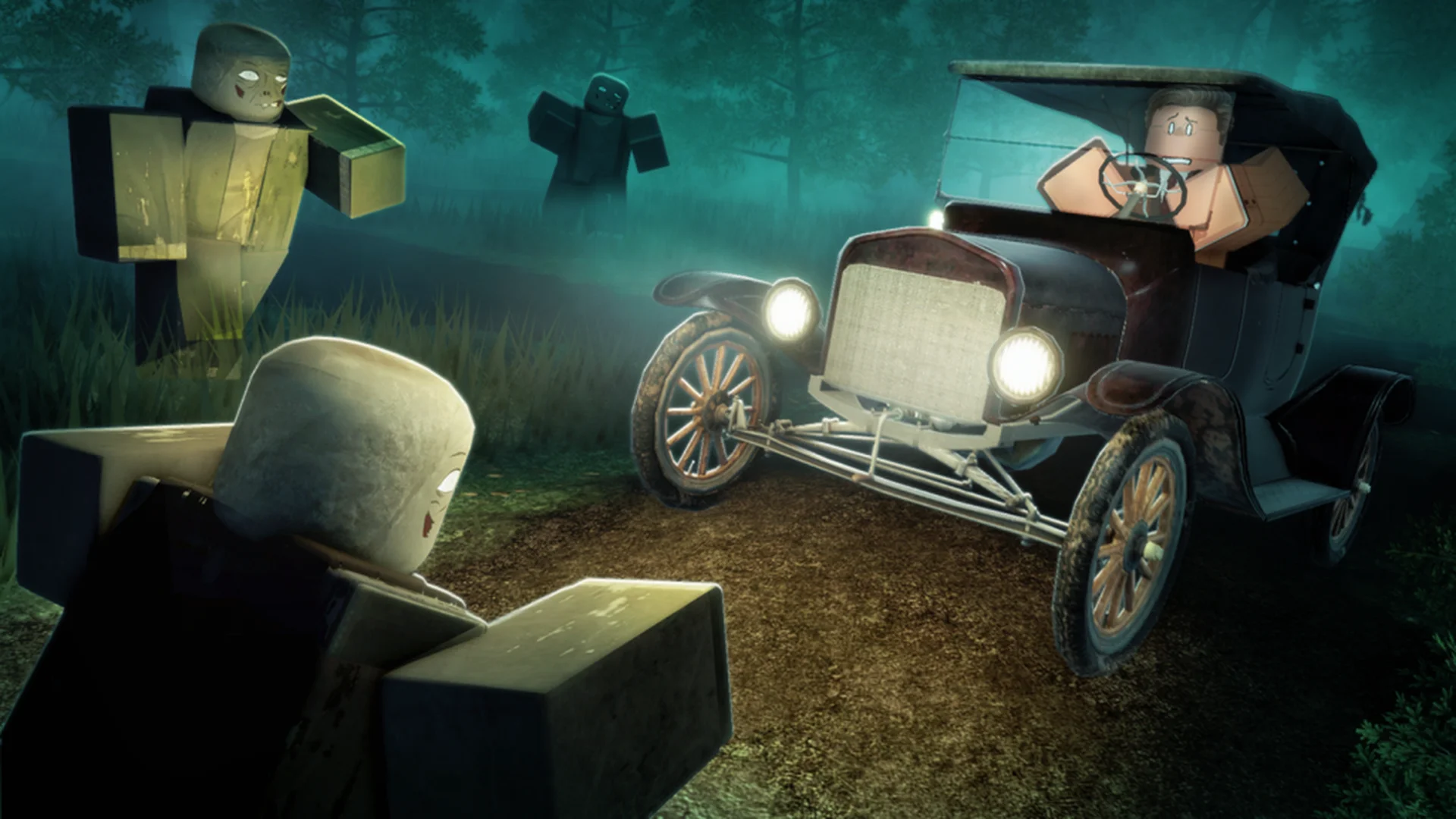
- Road to Ruin online gameplay centers on driving, scavenging, combat, and team survival.
- Prepare first by checking vehicle condition, supplies, inventory space, and team readiness.
- Stay together during dangerous sections, enemy encounters, and major objective pushes.
- Share resources instead of allowing one player to carry every essential item.
- Retreat early when the team is separated, weakened, or carrying valuable loot.
Road to Ruin online gameplay: How the Core Loop Works
Road to Ruin online gameplay takes place in a Roblox multiplayer survival horror experience set on a cursed 1930s road. The main loop combines vehicle travel, location-based scavenging, resource management, hostile encounters, and cooperative progression. The game is currently described as an ALPHA release, so routes, enemy behavior, item availability, and objectives may change as development continues.
A successful journey is not based on fighting every enemy or collecting every visible item. Instead, teams must decide what is worth carrying, when to return to the vehicle, and whether an optional detour provides enough value to justify its danger.
| Gameplay Phase | Main Objective | Best Practice |
|---|---|---|
| Preparation | Check the vehicle, supplies, and inventory | Assign shared resources before leaving |
| Travel | Move through dangerous road sections | Keep the team within supporting distance |
| Scavenging | Search locations for useful items | Prioritize survival supplies and objective items |
| Combat | Respond to hostile encounters | Fight only when the threat blocks progress |
| Regrouping | Return to the vehicle or checkpoint | Unload supplies and reassess the route |
| Progression | Complete the next objective | Preserve enough resources for later sections |
Vehicle Management
The vehicle is the team’s central travel and storage point. Check fuel, available space, and regrouping plans before moving into a new area.
Scavenging Discipline
Search locations in a planned order. Keep room for high-value discoveries and avoid carrying low-priority items when storage is limited.
Team Survival
Stay close enough to respond to danger. A separated player can turn an ordinary encounter into a rescue situation.
Treat every road section as part of one longer journey. Spending all ammunition, healing, or fuel during the first stop can make later objectives much harder.
For the current Roblox listing and public game information, use the Road to Ruin Roblox search page and the available Road to Ruin experience overview.
Beginner Setup Before Your First Journey
New players should establish a simple preparation routine before leaving the vehicle. The most common avoidable mistakes are traveling without enough supplies, filling storage with low-value loot, and moving ahead before every teammate is ready.
Use the following sequence at the start of each run:
Check the Team
Confirm that every player understands the next destination and has enough space for useful loot. Choose a route lead, a scavenger, and a player responsible for watching the vehicle or shared supplies.
Review Essential Supplies
Check food, medical supplies, fuel, weapons, and ammunition. Do not assume that one player can carry everything the group may need.
Set a Search Pattern
Decide which nearby locations will be searched first. Start with areas close to the vehicle so the team has a manageable retreat route if danger appears.
Protect Inventory Space
Leave room for objective items and valuable discoveries. Discard or leave behind low-priority duplicates when storage becomes crowded.
Confirm the Retreat Plan
Agree on where the team will regroup if combat begins. A clear fallback point prevents players from escaping in different directions.
| Preparation Check | Why It Matters | Recommended Decision |
|---|---|---|
| Vehicle status | Travel and regrouping depend on the vehicle | Check it before every major departure |
| Medical supplies | Injured players reduce team safety | Distribute them across more than one player |
| Fuel | Future movement may depend on it | Track fuel as a shared resource |
| Ammunition | Combat resources can be difficult to replace | Save it for confirmed threats |
| Inventory space | Full storage prevents valuable pickups | Keep several open slots |
| Team position | Separation increases rescue risk | Leave only when everyone is ready |
Do not send one player deep into a location while the rest of the team remains near the vehicle. Search distance should match the group’s ability to retreat and provide support.
First Journey Checklist:
- Check the vehicle and shared storage
- Assign a route lead and scavenging role
- Carry medical supplies and essential travel resources
- Leave space for objective items
- Choose a clear regrouping point
Co-op Roles for Online Teams
Road to Ruin may still be developing its formal character or class systems, but online teams can use practical roles to improve coordination. These roles describe responsibilities rather than permanent character choices, making them useful in both fixed groups and public servers.
| Team Role | Primary Focus | Best Contribution |
|---|---|---|
| Survival Lead | Route control and team safety | Chooses when to advance, fight, or retreat |
| Scavenger | Loot collection and inventory efficiency | Finds valuable supplies without overextending |
| Combat Guard | Threat response and protection | Stays near vulnerable teammates during encounters |
| Support Runner | Recovery and supply coordination | Tracks separated players and moves shared resources |
| Vehicle Keeper | Storage and regrouping | Maintains a reliable return point for the team |
Survival Lead
Calls out hazards, controls movement, and prevents the team from splitting during dangerous sections.
Scavenger
Searches efficiently, prioritizes useful items, and returns to the vehicle before the route becomes unsafe.
Combat Guard
Watches for approaching enemies, protects the group, and avoids chasing threats away from the route.
Support Runner
Carries shared supplies, assists separated teammates, and helps the group recover after an encounter.
The strongest team setup is usually balanced rather than combat-focused. A group with several players carrying weapons may still struggle if nobody tracks fuel, medical items, storage space, or the return route.
Use short callouts that communicate action and location:
- “Enemy near the next building.”
- “Return to the vehicle.”
- “Medical item in shared storage.”
- “Wait before activating the objective.”
- “Search complete; regroup now.”
A role does not need to be permanent. Players can switch responsibilities between locations, but announce the change so the team always knows who is carrying supplies and who is leading movement.
Combat, Loot, and Route Decisions
Combat should support progression rather than replace it. Before engaging, identify whether the enemy blocks the objective, threatens the vehicle, or can be avoided through a safer route. Preserving supplies is especially important during an Alpha journey because later sections may require additional healing, ammunition, or fuel.
| Encounter Type | Danger Level | Recommended Response |
|---|---|---|
| Standard hostile encounter | Moderate | Stay together and focus on the nearest threat |
| Special enemy group | High | Hold a defensible position and avoid splitting |
| Boss-level encounter | Very high | Prepare health, ammunition, roles, and escape space |
| Environmental threat | Variable | Scout slowly and retreat before the route collapses |
Loot should be evaluated by purpose, scarcity, and timing. The most valuable item is not always the rarest item; it is often the resource that keeps the team moving through the next section.
| Loot Category | Carry Priority | Use Timing |
|---|---|---|
| Food | High on long routes | Use when the team can gain meaningful recovery |
| Medical supplies | Very high | Reserve for serious injuries or dangerous transitions |
| Fuel | High when travel depends on it | Spend after confirming the next movement objective |
| Weapons | High for combat-focused players | Equip before known danger areas |
| Ammunition | Very high when ranged weapons matter | Use on confirmed threats and high-risk targets |
| Miscellaneous resources | Medium, or high for objectives | Keep items tied to active progression |
A reliable route follows a repeating pattern: prepare, search nearby locations, return to the vehicle, redistribute supplies, and advance only after the team is ready. Higher-yield detours can provide more resources, but they also expose the group to longer travel, additional encounters, and greater separation risk.
Choose the safe route when the team is low on medical supplies, ammunition, or fuel. Consider a high-yield detour only when the group has enough resources to recover from an unexpected encounter.
| Route Choice | Benefits | Risks |
|---|---|---|
| Safe route | Lower exposure and easier regrouping | May provide fewer extra supplies |
| High-yield detour | More opportunities for loot and utility items | Adds travel time and encounter risk |
| Direct objective push | Faster progression | Can begin an encounter without preparation |
| Thorough search | Better chance of finding resources | May overextend the team and fill storage |
A Practical Online Survival Route
The following route structure works as a flexible framework for early journeys. Specific locations and resource placements may change during the Alpha period, so use the sequence rather than treating it as a fixed map.
Prepare at the Starting Node
Check health, supplies, weapons, ammunition, fuel, and inventory space. Assign roles and confirm the next objective.
Search the Closest Location
Begin with an accessible area near the vehicle. Take essential supplies first and leave low-value items if storage becomes limited.
Return and Redistribute
Bring useful items back to the vehicle. Share medical supplies, fuel, ammunition, and objective-linked resources before continuing.
Cross the Dangerous Section Together
Move as a compact group, avoid unnecessary fights, and maintain a clear retreat path. Do not chase enemies away from the team.
Secure the Objective Area
Check team condition and escape options before activating a major objective. Save enough resources for the encounter and the next return trip.
| Route Stage | Priority | Stop Condition |
|---|---|---|
| Starting node | Preparation | Everyone is equipped and informed |
| Nearby search | Essential loot | Storage is useful, not overloaded |
| Vehicle return | Redistribution | Shared resources are balanced |
| Dangerous section | Survival | Team reaches the next safe position |
| Objective area | Progression | Objective is completed without exhausting reserves |
The key decision is knowing when to stop searching. Leave an area when the team has the essential supplies, when enemies begin arriving from multiple directions, or when one player is carrying valuable objective items that should be protected.
Recheck route notes after major 2026 updates. Alpha changes may affect map structure, resource placement, enemy behavior, and objective flow.
Road to Ruin Online Gameplay FAQ
Q: What is Road to Ruin online gameplay focused on?
It focuses on cooperative survival across a dangerous 1930s road. Players prepare a vehicle, search locations, manage supplies, respond to enemies, and complete objectives together.
Q: What should beginners do before leaving the vehicle?
Check the vehicle, health, food, medical supplies, fuel, weapons, ammunition, and inventory space. Then assign simple team roles and choose a regrouping point.
Q: Should online teams fight every enemy they encounter?
No. Fight when an enemy blocks progress or threatens the group, but avoid unnecessary encounters when the team is low on supplies or carrying valuable loot.
Q: What is the best way to manage loot?
Treat essential resources as shared team property. Prioritize medical supplies, fuel, ammunition, food, and objective items, then return to the vehicle regularly to redistribute them.
The safest online runs come from preparation, compact movement, shared resources, and early retreat decisions. Build consistency first, then explore riskier routes as your team becomes more coordinated.