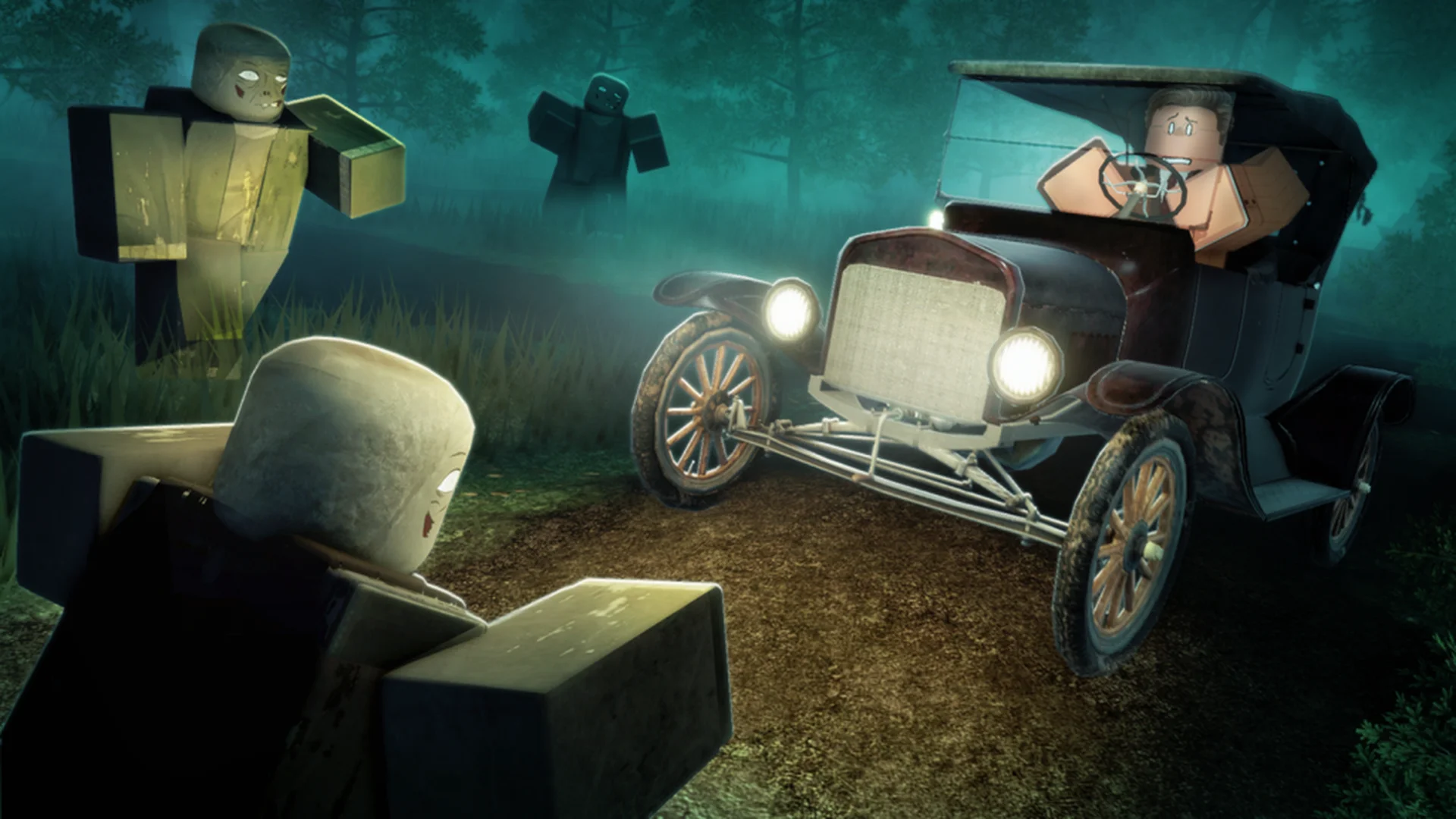
- Road to Ruin Roblox gameplay centers on driving, scavenging, combat, and team survival.
- Prepare first by checking the vehicle, supplies, inventory space, and team readiness.
- Travel together and return to the vehicle regularly to unload valuable resources.
- Choose carefully between fighting, searching, taking a safer route, or retreating.
- Alpha status means map layouts, enemy behavior, and resource priorities may change.
Road to Ruin Roblox Gameplay: Core Loop
Road to Ruin Roblox gameplay follows a repeatable survival loop: prepare a vehicle, search dangerous locations, collect useful supplies, travel through hostile areas, and complete objectives as a team. The game is presented as an ALPHA multiplayer survival horror experience from Studio Lumis, set on a cursed 1930s road.
The most important decision is not how much you can carry. It is whether the items, route, and risk are worth spending the team’s limited time and supplies. A successful journey usually combines short scavenging trips, regular regrouping, and a clear retreat plan.
Prepare
Check the vehicle, inventory space, health, weapons, ammunition, fuel, and essential supplies before leaving.
Scavenge
Search nearby locations in a planned order. Prioritize survival resources and objective items over low-value duplicates.
Survive
Stay close, control enemy pressure, protect the vehicle, and retreat before the team loses too many supplies.
| Gameplay Phase | Main Goal | Common Mistake | Better Approach |
|---|---|---|---|
| Preparation | Build a flexible starting loadout | Leaving without checking shared supplies | Confirm the team plan before departure |
| Scavenging | Collect useful loot efficiently | Searching every area without a return route | Start nearby and keep the vehicle location clear |
| Travel | Reach the next road section | Spending resources too early | Save key supplies for later danger zones |
| Combat | Remove or avoid threats | Chasing enemies away from teammates | Fight from a position with a retreat path |
| Objective | Complete the current task | Triggering danger while unprepared | Check health, ammunition, and escape options first |
Treat the vehicle, storage space, fuel, medical supplies, and ammunition as shared team resources. Personal loot matters less than keeping the journey moving.
Step-by-Step Survival Setup
The strongest beginner setup is simple: prepare the group, establish a route, and create a rule for returning to the vehicle. The available public information describes vehicle travel, resource scavenging, enemy encounters, and co-op survival as the main pillars of the experience.
Check the Vehicle and Inventory
Before moving out, review vehicle readiness, storage space, fuel requirements, and each player’s current supplies. Leave room for valuable discoveries instead of filling every slot immediately.
Assign Team Responsibilities
Give each player a clear role such as route lead, scavenger, combat guard, or support runner. Flexible role assignments work well while the Alpha version develops its formal systems.
Choose the First Search Area
Start with a nearby location that allows the team to return quickly. Search in a consistent order and avoid splitting into separate buildings or distant paths without communication.
Return and Redistribute Supplies
Bring important resources back to the vehicle regularly. Move medical supplies, fuel, ammunition, and objective items to the players who need them most.
Confirm the Next Decision
Before advancing, decide whether the team will continue, search a side area, fight, or retreat. A short group decision prevents players from moving in opposite directions.
| Setup Check | Priority | Why It Matters |
|---|---|---|
| Vehicle condition | High | Travel and regrouping depend on reliable vehicle access |
| Medical supplies | Very high | A weakened teammate can increase the risk for the whole group |
| Fuel | High when travel requires it | Running short can interrupt route progression |
| Ammunition | High before danger zones | Combat resources may be limited during longer journeys |
| Inventory space | Medium to high | Empty slots allow the team to collect more valuable resources |
First Journey Checklist:
- Check the vehicle and confirm the departure plan
- Assign a route lead and a shared-supplies player
- Keep inventory space open for valuable loot
- Search nearby areas before taking long detours
- Regroup at the vehicle before entering a dangerous section
For an early run, prioritize returning with essential supplies and objective progress. A safe extraction with moderate loot is more useful than a risky search that separates the team.
Route Planning and Scavenging Priorities
Route planning is one of the most important parts of Road to Ruin Roblox gameplay. The safest route is not always the route with the most loot. A high-yield detour may expose the group to extra enemies, longer travel, limited visibility, or a difficult return trip.
Use a route structure with five practical stages: departure, scavenging, resupply, dangerous transition, and objective completion. Recheck route information after Alpha updates because map structure, resource placement, and enemy behavior can change.
| Route Stage | Safe Option | High-Yield Option | Main Risk |
|---|---|---|---|
| Starting road node | Confirm supplies and leave quickly | Search the starting area thoroughly | Delaying without a clear benefit |
| Scavenging area | Search accessible containers near the route | Explore side areas and secondary locations | Staying exposed for too long |
| Supply point | Restock essential categories | Refill several resource types | Spending supplies before the next objective |
| Dangerous segment | Move as a compact group | Explore contested side paths | Losing ammunition or healing resources |
| Objective area | Prepare before activation | Search nearby areas before triggering danger | Starting a major encounter too early |
A practical scavenging order is:
- Search locations closest to the vehicle first.
- Take medical supplies, fuel, ammunition, and objective-linked items seriously.
- Leave low-value duplicates when storage is limited.
- Return to unload before the team becomes separated.
- Keep one clear path open for retreat.
Safe Route
Lower exposure and fewer unnecessary fights. Best when supplies are limited or the team is learning the map.
High-Yield Route
More search opportunities and potentially better resources, but greater travel time and encounter risk.
Fallback Route
A known return path to the vehicle or previous checkpoint when the team becomes injured, separated, or low on ammunition.
Do not continue searching simply because an area still has unopened containers. If the team is carrying valuable loot, returning safely can be the highest-value decision.
Co-op Roles, Combat, and Retreats
Road to Ruin is designed around multiplayer cooperation, so communication is more important than assigning a perfect build. While the Alpha version may not have a fixed class system, practical roles make public servers and private groups easier to manage.
| Role | Main Responsibility | Strongest Contribution | Watch For |
|---|---|---|---|
| Survival Lead | Route control and team movement | Decides when to advance, fight, or retreat | Taking every decision alone |
| Scavenger | Loot collection and inventory efficiency | Finds valuable resources quickly | Wandering too far from support |
| Combat Guard | Threat response and teammate protection | Controls pressure during encounters | Chasing enemies away from the group |
| Support Runner | Recovery and supply coordination | Helps separated players and moves shared items | Carrying essential supplies without telling the team |
During combat, focus on positioning rather than chasing every target. Keep the group close enough to support one another, use defensible terrain when available, and preserve ammunition for threats that block progress or endanger several players.
A useful combat priority is:
- Identify whether the encounter can be avoided.
- Keep a retreat path open.
- Focus on the nearest threat that can reach the team.
- Avoid splitting damage across too many targets.
- Retreat when the objective is complete or resources become too low.
Hold Position
Use when the group has cover, a clear escape route, and enough supplies to control the encounter.
Fall Back
Use when enemies are multiplying, the team is separated, or the group is losing health and ammunition too quickly.
Skip the Fight
Use when the encounter does not protect an objective and the route allows safe movement around it.
Use short callouts such as “vehicle,” “behind,” “retreat,” “low health,” and “objective ready.” Clear information is more valuable than constant voice chat.
Loot Management and Alpha-Friendly Habits
Loot decisions should be based on the next danger area, remaining route length, team condition, and available storage. Food, medical supplies, fuel, weapons, ammunition, and miscellaneous resources each serve a different purpose, so avoid treating every item as equally valuable.
| Loot Category | Carry Priority | Best Use | Team Rule |
|---|---|---|---|
| Food | High on long routes | Use when the team can gain meaningful recovery | Share instead of stacking it on one player |
| Medical supplies | Very high | Save for serious injuries or dangerous transitions | Spread healing resources when practical |
| Fuel | High when travel requires it | Spend for necessary vehicle progression | Assign one player to track fuel |
| Weapons | High for combat roles | Equip before known danger areas | Match equipment to team roles |
| Ammunition | Very high for ranged tactics | Use on confirmed or high-risk threats | Transfer spare rounds to the key combat player |
| Miscellaneous resources | Medium, rising for objectives | Keep items connected to active tasks | Drop duplicates when essential space is needed |
The Alpha status also changes how you should read strategy guides. A route or item priority that works on October 25, 2026, may need adjustment after a balance change, map revision, or enemy update. Use current in-game behavior as the final check.
Treat unconfirmed enemy names, exact spawn locations, item statistics, and formal class rankings cautiously. The reliable strategy is to verify what the current build actually uses.
For official access, use the Road to Ruin Roblox search page. The available game information also identifies Studio Lumis’ Road to Ruin listing as a reference point for the experience.
Road to Ruin Roblox Gameplay FAQ
Q: What is the main Road to Ruin Roblox gameplay loop?
Prepare the vehicle and team, search dangerous locations, collect useful supplies, travel through hostile road sections, complete objectives, and return with enough resources to continue.
Q: What should beginners do first?
Check the vehicle, leave inventory space open, assign simple team roles, search nearby locations, and return to unload important supplies before taking longer detours.
Q: Should the team fight every enemy encounter?
No. Fight when a threat blocks progress or creates immediate danger. Otherwise, preserve ammunition and health by using distance, positioning, or a safer route.
Q: Does Road to Ruin have a fixed class system?
The available Alpha information supports practical team roles such as survival lead, scavenger, combat guard, and support runner. Formal classes may change as development continues.
The best survival habit is consistent regrouping: prepare together, search with a route, share resources, and retreat before a manageable problem becomes a failed journey.